Showing posts with label how-things-are made. Show all posts

Monday, July 29, 2013

Australian Stories

VPAU 560: Explore a current issue of significance in Australia / Explore a current issue of of international significance
VPAU505.4: Write a descriptive or narrative text


 WRITING:  Watch the video with a friend.

Exercise 1: What is the story about? Who are the characters? When was the video made? What is the attitude to refugees? (Talk about this)

Exercise 2: Watch the video together again and correctly order the sentences and phrases ...

and the Australian way of life.
changed everything.
Ali arrived in Australia nine years ago
before the civil war
Ali's wife...
and dream of owning their own farm.
He once owned his own farm.
Ali and his wife have worked hard...
Refugees...
A new country...
actively contribute
They are saving money...
to Australian communities
makes for new challenges.
to make a new life.
is one of the town's doctors

Exercise 3: Write the phrases into a story (without looking at the video)


GRAMMAR: The First Conditional


Worksheet: Review the FIRST CONDITIONAL (if + present simple + will/may/might

LISTENING / VIEWING COMPREHENSION / DISCUSSION:

Should Quad Bikes Be Banned?


Discussion Questions

1. What was the main point raised in the Quad Bikes story?

2. Most people who ride quad bikes live:
a. Near the beach
b. On farms
c. In the city

3. What are the benefits of having a quad bike on a farm?

4. How many people died from quad bike accidents in Australia last year?

5. Kids of any age are legally allowed to ride quad bikes. True or false?

6. There are no laws saying that kids have to wear __________ while riding a quad bike.

7. Why do some people want to see changes to the way quad bikes are designed?

8. Give some examples of improved quad bike safety.

9. List the arguments for and against making stricter rules for quad bike riders.

10. What do you think should happen next?

Transcript of the video

Download the entire ABC TV Activity Unit - Persuasive Texts

  GIVING AND ASKING FOR DIRECTONS : VPAU 503.3/503.4
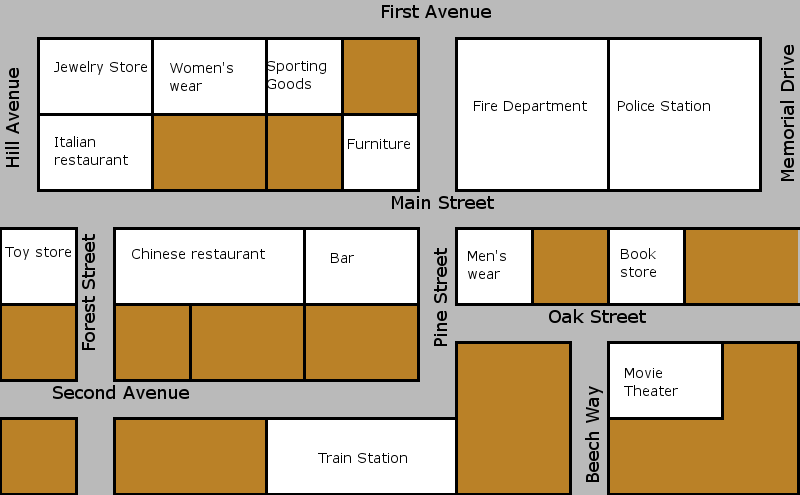
                                                                                                          X You are here

Exercise 1: With your teacher or a classmate, give and ask directions using the map

Exercise 2: Complete these online exercises using the same map (from englishonline.org)


GRAMMAR 2 : Something made of/in/from / Something used for (Passives and Past Participles)

Download this board game and play with a friend (you will need dice and a coin) - From ESL Tower


Vocabulary: Crossword Puzzle "What is it made of?" (Download the puzzle and answers)

Tuesday, October 5, 2010

Natural (and Everyday) Disasters

***

Make a list of the "household disasters" you see in the video. Which ones are common? Which ones are ridiculous? Which ones are really dangeous?


Have you got a short story to tell about a common, household disaster? Leave your story on our student Phlog at ipadio. (Use the number and codes I gave you in class).

The 24th of August, 79 AD started like any other day ...


(scroll down for more activities about Pompeii)

Volcanoes - Reading and Writing for Information (Level 3)


As you know I spent my holiday in Sumatra, an island in Indonesia with very active volcanoes.

How and why do volcanoes erupt? Watch the Volcano Song ...

1) Note the key words
2) Can you explain what happens?


3) Watch this BBC slideshow for more information

4) Tsunamis, earthquakes, tornadoes, typhoons ... look at other BBC slide shows and prepare a short written description. How do they happen? Where do they happen? How do they affect lives?

We read about "Super-volcanoes" in class. If Yellowstone National Park explodes the world will be in a lot of trouble. We talked about two past eruptions in class - Krakatoa in the 19th Century and Pompeii in 79AD.
POMPEII


In 2009, Melbourne Museum held an exhibition called A Day in Pompeii

CLICK HERE TO VISIT THE VIRTUAL EXHIBITION Can you find the virtual cinema? Watch the three movies about the eruption of Mt.Vesuvius

1. Watch the short video called The House of the Vine.

2. Read the section DAILY LIFE. Was life in Pompeii the same for everyone?

GRAMMAR - The Passive Voice

to be + past participle

eg. Volcanic eruptions are caused by the build up of pressure.
eg. Glass is made from sand.

Remember, we use the passive voice when the object, not the subject, of an action is most important.

Exercise One:

Complete this online exercise about the passive.

KRAKATOA : The Last Days (Part 1)

This is a short BBC film about the eruption of Krakatoa which took place in 1883 and killed over 36,000 people. The film shows a Dutch family, the Bejjernicks, trying to escape the volcano on a ship with more than 100 passengers ...


What would you do if you were at Krakatoa in 1883?

Watch the other parts of the movie at YouTube.


***

LEVEL 1 : Taking Phone Messages


1. Use the BLANK message sheet I gave you in class. Listen to the telephone conversation. Fill in the message sheet.
2. Questions:

Who is the message for?
Who took the message?
Who called?
What is the message?
What is Phil's number?


Level 2 examples ... (a little bit more complicated!


***

Sunday, August 16, 2009

Week 6, Term 3 : How is silk made?


CLICK HERE TO WATCH THE VIDEO

Level 3

This week we are writing about HOW THINGS ARE MADE. In class last week you studied How Tea is Produced and Distributed. You also know about How Bananas are Produced and Shipped to Europe and America.

Watch the video above about HOW SILK IS MADE in Bangladesh.

Complete the following exericse:

Instructions:

(i) Put the steps in the correct order
(ii)Change the sentences from ACTIVE voice to PASSIVE voice


A) The women immerse the coccoons in boiling water. The silk worm inside the coccoon dies.

B) The women collect and sort huge piles of golden silk worm coccoons

C) The women wind the raw, silk thread onto a spindle. They dry it and then ship it to a textile factory

D) After boiling, the women cool the coccoons and take them to a loom. They unravel the coccoons onto the spool.

TO READ THE SCRIPT (& FIND THE ANSWERS) CLICK HERE